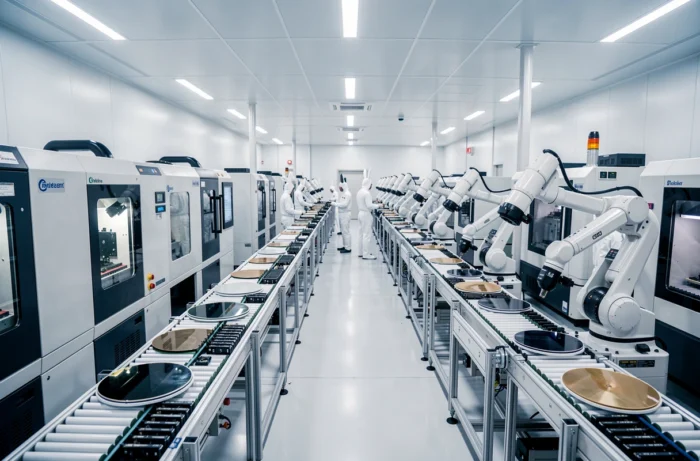
The processor market is no longer just a face-off between two Californian giants. The distinction between designer and physical manufacturer is redefining power dynamics, and several players long confined to mobile or subcontracting are now occupying strategic positions in the PC and server segments.
Foundry and design: two distinct roles in the processor market
A processor bears the brand of its designer, not that of the factory that manufactures it. This separation between design and manufacturing (the fabless model) currently structures the majority of the value chain. AMD, NVIDIA, Qualcomm, Apple, and MediaTek design their chips without owning production lines. They outsource manufacturing to third-party foundries.
TSMC accounts for over 70% of the global foundry revenue, according to Counterpoint data from the first quarter of 2026. Samsung, Intel Foundry, and SMIC share the rest, with considerable gaps. When we analyze the main processor manufacturers, this distinction between designer and foundry radically changes the market perspective.
Intel remains one of the few players to combine design and manufacturing in-house, a model known as IDM (Integrated Device Manufacturer). Samsung holds a similar position, designing its own Exynos while operating a foundry division for external clients.
Intel and AMD: x86 architectures and divergent strategies
Intel and AMD share the x86 architecture, but their industrial trajectories have little in common now. AMD abandoned its factories in 2009 to become fabless, entrusting its entire production to TSMC. This decision allows it to benefit from the most advanced manufacturing nodes without bearing the colossal cost of fabs.
Intel is taking the opposite path. The company is investing heavily in its Intel 18A process, aiming to reposition itself among leading foundries. The stakes go beyond the competitiveness of its own processors: Intel aims to manufacture chips for third-party clients, directly competing with TSMC and Samsung.
In the server segment, AMD has captured a significant market share with its EPYC, while Intel defends its Xeon. In the consumer PC sector, the dynamics become more complicated with the arrival of Arm processors that are nibbling away at market shares, according to Mercury Research data from September 2026.
Arm, Apple, and Qualcomm: the architectural shift in PCs
The Arm architecture is no longer reserved for smartphones. Apple has imposed its M-series chips across its entire Mac range, and Qualcomm is pushing its Snapdragon X in the Windows segment. These Arm processors boast a performance-per-watt ratio that puts pressure on traditional x86 designs.
- Apple Silicon (M1 to M4): internal design, TSMC manufacturing, strong vertical integration with macOS optimized for the architecture
- Qualcomm Snapdragon X Elite/Plus: targets Windows ultraportables with internally designed Oryon cores, manufactured at TSMC
- MediaTek: a dominant player in Android smartphones, positioned in Chromebooks and connected devices with competitive Arm SoCs
This architectural shift is reshuffling the cards. The Intel-AMD duopoly in laptops, taken for granted for two decades, is facing measurable erosion. Mercury Research data shows that Arm processors are reaching record market shares in PCs in 2026.
NVIDIA and the processor as an AI accelerator
NVIDIA does not manufacture traditional CPUs for consumer PCs, but its position in the processor landscape has become central. Its GPUs (Grace Hopper, Blackwell) serve as the computing engine for training and inference of artificial intelligence models. The company also designs Arm CPUs (Grace) intended for data centers.
All NVIDIA production goes through TSMC. This dependence illustrates the concentration of industrial risk: the majority of global AI chips come from the same Taiwanese factories.
TSMC, Samsung, and SMIC: the race for the 2 nm node
The competition among foundries is now played out on the finest manufacturing processes. TSMC leads in volume production at the 2 nm node, with a technological lead that Samsung is trying to close.
SMIC, the leading Chinese foundry, continues to strengthen its position in a strategy of Chinese industrial sovereignty.
Intel is betting on its 18A process with gate-all-around (GAA) transistor technology, shared with TSMC and Samsung on their respective 2 nm nodes and below. This type of transistor replaces the FinFET used for over a decade and promises gains in density and energy efficiency.
Market size and geographical distribution
North America remains the largest processor market, but the Asia-Pacific region shows the fastest growth.
- South Korea: Samsung and SK Hynix (memory and foundry)
- Taiwan: TSMC and MediaTek, pillars of the global fabless chain
- Japan: Rapidus, a new consortium aiming for advanced chip production with massive state support
- China: SMIC and Huawei HiSilicon, key players in the Chinese semiconductor industry
The concentration of advanced manufacturing in Taiwan remains the major point of fragility for the entire industry. This industrial reality weighs on the investment decisions of the American, European, and Japanese governments, all of which are funding programs to relocate semiconductor production.