
The DTC038061 code appears on certain Renault diesel vehicles during a diagnostic reading, often associated with a problem in the preheating circuit. Its uniqueness lies in its designation: it is an internal code within the Renault system, distinct from generic OBD-II codes like P0380. This difference in nomenclature regularly leads to confusion during diagnostics and sometimes results in inappropriate repairs.
Renault DTC038061 Code and Generic Code P0380: A Common Confusion
Renault diagnostic tools use internal codes prefixed with “DF,” while a generic OBD reader translates faults into standardized “P” codes. The P0380 code, for example, indicates a malfunction in the preheating circuit “A” on any diesel vehicle. In contrast, a DTC038061 code should not be interpreted as a simple P0380 without identifying the relevant ECU.
The correlation between these two codes depends on the engine ECU and the engine type. On some dCi engines, P0380 is associated with DF025, not necessarily with DTC038061. Reading a generic code on a universal scanner and then replacing the glow plugs without checking the full wording of the Renault fault can lead to unnecessary intervention.
To clarify any doubts, it is relevant to discover the DTC038061 code on Auto Test to compare the exact wording of the fault with the manufacturer’s data.
Engine Temperature Sensor: The False Culprit of Preheating
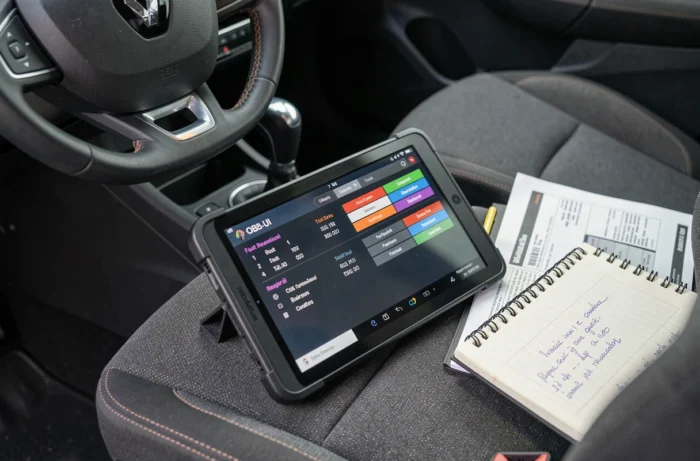
A rarely explored angle concerns the role of the coolant temperature sensor in preheating anomalies. On certain Renault diesel ECUs, a faulty temperature sensor can impose prolonged preheating and trigger the engine fan operation even when the actual temperature does not justify it.
This fault, sometimes referenced as DF001 or P0115, sends an aberrant temperature value to the ECU. The system reacts by activating the glow plugs longer than necessary, even keeping the warning light on.
The symptoms can easily be confused with a failure of the preheating relay or the glow plugs themselves. The trap is classic: the owner replaces the plugs, the problem persists, and the real fault (the sensor) remains in place. Before any intervention on the preheating circuit, checking the consistency of the engine temperature sensor value using a tool capable of displaying real-time parameters avoids this type of error.
Diesel Preheating Circuit Diagnosis: Step-by-Step Methodology
The relevant procedure for addressing a preheating-related code on a Renault diesel does not start with replacing the glow plugs. It follows a logical order that moves from the ECU to the components.
- Identify the relevant ECU, the full wording of the fault, and the associated codes with a compatible Renault tool (not just a generic OBD reader)
- Compare the displayed code with the manufacturer’s documentation to determine if the fault concerns the plugs, the relay, the control unit, or a peripheral sensor
- Measure the resistance of each glow plug with a multimeter: a broken plug shows infinite resistance, while a short-circuited plug shows a value close to zero
- Check the power supply to the relay or preheating unit, as well as the condition of the wiring harness and connectors
- Verify the coolant temperature sensor value to rule out an information fault sent to the ECU
This systematic approach allows for identifying the real cause before ordering parts. Replacing glow plugs solely based on a generic P0380 code can lead to a poor repair.
Renault Preheating Light: What It Really Indicates

The spiral-shaped light on the Renault dashboard is often perceived as a direct indicator of the condition of the glow plugs. The preheating light is not a reliable test of the plugs themselves. Its behavior (prolonged illumination, blinking, appearance when the engine is warm) can signal very different issues.
A light that stays on after starting may indicate a fault in the preheating relay, an issue with the electrical harness, or even a problem related to injection. On some models, this same light serves as a generic alert for several types of engine faults.
The normal duration of the light’s illumination varies according to the outside temperature and engine temperature. In mild weather, it may turn off almost instantly. In very cold weather, it stays on for several seconds. An abnormally long illumination does not necessarily mean that the plugs are out of service: the ECU may extend the cycle if the temperature value it receives is incorrect (returning to the sensor issue mentioned earlier).
Renault Diagnostic Tools: Universal Scanner or Manufacturer Tool
A generic OBD reader is sufficient to read a P0380 code and confirm that a fault exists in the preheating circuit. However, it is not enough to interpret an internal code like DTC038061. Field feedback varies on the reliability of universal scanners for specific Renault codes.
Tools compatible with the Renault protocol (formerly CAN/CLIP) display “DF” codes with their full wording, stored faults, present faults, and allow for real-time parameter visualization. This granularity makes the difference between an approximate diagnosis and a precise identification of the component involved.
For an owner wishing to diagnose themselves, a tool capable of reading Renault manufacturer codes is a prerequisite before any mechanical intervention. High-end multi-brand scanners generally offer this compatibility, but entry-level models often limit themselves to generic codes.
The DTC038061 code illustrates the complexity of diagnosing Renault diesel vehicles. The correspondence between internal codes and generic codes is not always direct, and preheating symptoms can mask a fault located elsewhere in the ECU’s information chain. Identifying the relevant ECU, reading the full wording, and measuring each component remains the only method that avoids replacing parts at random.