The surface of a sloped wall never corresponds to that of a straight wall of the same width and maximum height. Geometry imposes its own calculations, often overlooked during initial estimates, which skews quotes and material forecasts.
Calculation methods exist to obtain a reliable measurement without resorting to complex professional tools. Some online tools offer automated solutions, helping to avoid common mistakes and save time. Renovation or construction professionals rely on precise formulas to ensure the accuracy of their interventions.
Why knowing the surface of a sloped wall is essential for your projects
Assessing the surface of a sloped wall is never a step to take lightly. The slope alters everything; the height fluctuates, and the length stretches differently at each point. On a construction site, every square centimeter counts. A precise calculation prevents ending up with too many materials on hand, or worse, running out at the last moment. It also affects the budget, quotes, and the amount of labor to be planned. At every stage, the wall surface dictates the course of action, from paint selection to ordering insulation.
For a renovation or construction, knowing the surface to calculate brings clarity: you establish a coherent budget, anticipate needs, and plan without unpleasant surprises. Paint, drywall, insulation—nothing is left to chance. The method for calculating the surface of a wall suited to each slope becomes the reference for maintaining control on the site.
It all starts with two measurements: the height and the length of the sloped wall. Measure the width at the base, the highest and lowest heights, then apply the formula that fits the geometry of the slope. This action, too often rushed, makes all the difference. Taking the time to measure prevents waste, allows for optimizing every euro invested, and ensures impeccable resource management, from the quote to the final installation. On a sloped wall, every square meter matters.
Understanding calculation methods suited to each type of sloped roof
Sloped roofs are not alike, and each configuration requires its own calculation. A gable roof, for example, typical of traditional houses, requires evaluating the surface of each side separately. For these cases, multiply the length by the width of the side, then double if both sides are identical.
Four-sided roofs, often more complex, require increased attention. Some sides are trapezoidal: add the upper base and the lower base, then multiply by the height of the side, before dividing by two. Add the different surfaces to obtain the total roof area. Any variation in shape or dimensions requires adjusting the method.
Here’s how to proceed based on the situation:
- For a simple sloped roof, simply multiply the length by the width.
- For a complex roof, break the surface down into basic shapes (rectangles, trapezoids), calculate each part, then add them up.
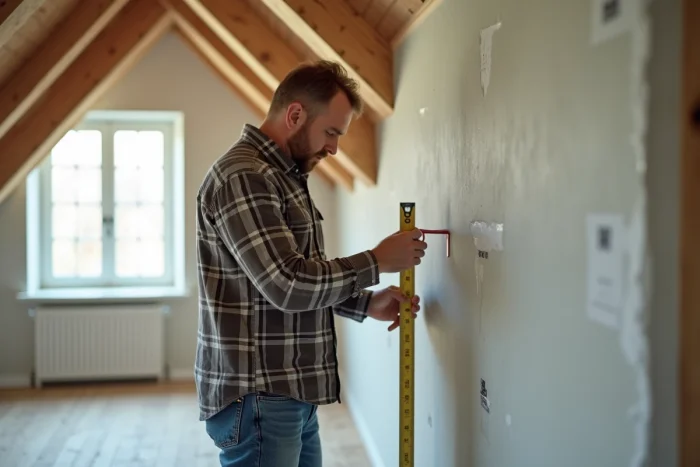
For old buildings or those with atypical geometry, site measurements are essential. A tape measure or laser rangefinder quickly becomes indispensable to ensure a precise surface calculation. Sometimes, it’s also necessary to consider the ground projection, so that the actual area to be covered is accurately measured. On a sloped terrain, a few adjustments may be necessary to leave nothing to chance.

Online simulators and practical tips: gaining precision and simplicity
On construction sites, whether professional or undertaken by knowledgeable individuals, a precise calculation of the surface of a sloped wall makes all the difference. Online simulators have become essential for quickly refining measurements. Just enter the height, length, and width to instantly obtain the surface to calculate and adjust the material order or prepare a quote from a craftsman or service provider.
Smartphone applications also play a key role, turning the phone into a true ally. Some feature an integrated bubble level to check the slope, while others offer calculation modules suited for atypical walls. By cross-referencing the information, the wall surface is displayed accurately, which limits surprises when ordering or negotiating the cost of labor.
Practical tips for reliable measurement
- Use a bubble level to ensure angles are correct.
- Take measurements with two people to limit inaccuracies.
- Test an online calculator to compare different scenarios before locking in the budget or requesting a quote.
Everything relies on the reliability of the initial measurements. An accurate survey combined with the use of a simulator allows you to proceed without fearing mistakes, from material selection to estimating the overall cost. This efficiency-precision duo accelerates decision-making and secures planning, whether tackling a terrace wall or an interior sloped partition.
Ultimately, mastering the calculation of the surface of a sloped wall opens the way to projects without unpleasant surprises and finishes that fully meet expectations.