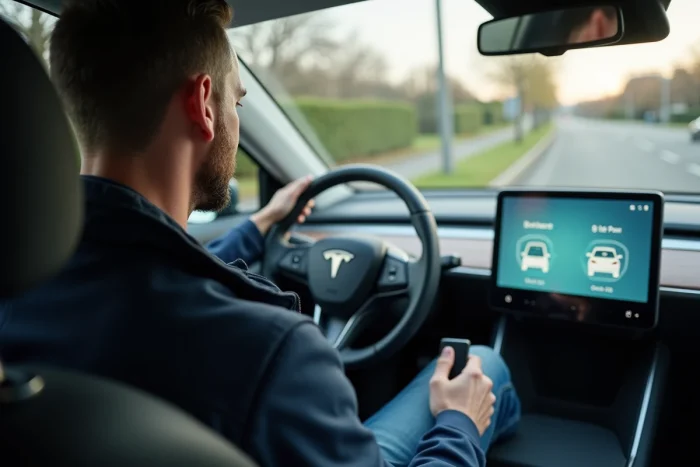
A cold number, a line of code, and there you have it: hundreds of electric kilometers that are written or erased beneath your tires, depending on whether your car is in B mode or D mode. Behind this simple letter on the gear lever lies much more than a technical detail: your range, your driving comfort, and the way each braking shapes your experience behind the wheel.
Mode B radically transforms the management of regenerative braking by engaging the electric motor to maximize energy recovery at each slowdown. On some models, this mode offers the best recharge; on others, it is mainly in D mode that recovery efficiency is optimized. This technical choice directly influences the amount of current reintroduced into the battery while driving.
The responsiveness of braking, the feel at the pedal, and the perceived range evolve depending on the activated mode. It can be difficult to navigate from one model to another: each manufacturer applies its own settings, and the nuance between B and D is often overlooked, even though it influences the routine of every electric vehicle driver.
B Mode vs D Mode: Changing the Rhythm of Electric Driving
Switching from D mode to B mode changes everything, even from the first acceleration. B mode: as soon as you lift your foot, the deceleration is felt more distinctly, the car captures energy to return to the battery, and the pressure on the mechanical brakes lightens. Slowdowns turn into range recovery, particularly in the city where stops are frequent. Users also note a real reduction in the wear of discs and brake pads after a few weeks.
On the other hand, D mode offers a driving experience closer to that of a gasoline or diesel vehicle. On national roads or highways, the car glides more freely, the “engine brake” is barely perceptible, leaving the driver in control of recovery via the brake pedal, in a way that feels more natural for many motorists accustomed to combustion engines. This mode allows for covering distances without feeling abrupt braking during deceleration.
If you’re looking for opinions and practical feedback, the debate over the choice between B or D for electric cars is particularly lively among drivers of models like the Renault ZOE. Some prefer B mode for urban driving, while others favor D mode on long trips. Preferences often follow the profile of the routes and the level of anticipation behind the wheel.
To better understand, here are the contexts in which each mode excels:
- B Mode: maximum recovery, one-pedal driving, perfect for the city or mountainous areas.
- D Mode: smoothness, stabilized speed routes, to be preferred on highways or major roads.
B Mode: An Ally for Energy Recovery and Range
Activating B mode is not just about pressing a button: it’s about transforming your driving. Every lift of the foot off the accelerator triggers regenerative braking, which converts kinetic energy into electricity, directly stored in the battery. In the city or on winding roads, the repetition of slowdowns maximizes the available range.
Two parameters nuance this recovery: the battery charge level and the outside temperature. Nearly full battery or winter weather? Recovery is less pronounced. Most of the time, B mode provides real added value without excessively straining the mechanics.
On board, most models display a visual indicator, gauge, or econometer, to estimate in real-time the intensity of recovery. This feedback encourages adapting driving habits and anticipating even more, seeking optimal regenerative braking without missing out on charging opportunities.
Remember the key strengths often mentioned regarding B mode:
- Immediate start of regenerative braking as soon as the accelerator is released
- Increased battery recharge, especially on urban routes
- Less wear on traditional brake pads

When to Choose B Mode or D Mode? Making the Right Choice Depending on the Situation
B mode shines in the city. On urban roads, where stops and starts punctuate the journey, it ensures powerful slowdowns and continuous recovery. Driving becomes smooth, sometimes one-pedal, while preserving the mechanical brakes. When a descent is approaching, B mode is also reassuring: it holds the vehicle back, channels excess speed, and accumulates energy, ideal for long slopes.
Conversely, for long highway stretches, the stability of D mode prevails. No sudden braking, a maintained pace, and very few interventions: perfect for covering distances without overconsuming or tiring the driver. This mode also reassures when the road becomes slippery, offering gentle and controlled deceleration.
Changing modes during a journey based on the environment or weather provides a real boost in control and comfort. The driver thus fully enjoys the modularity offered by today’s electric cars.
To quickly distinguish the best usage situations, rely on these guidelines:
- B Mode: priority in urban areas, during traffic jams, for approaching descents, or when anticipation becomes the rule.
- D Mode: recommended for long trips, fast lanes, and when traction diminishes.
Technology allows everyone the freedom to invent their own way of driving. Whether in B or D mode, just a few seconds are enough to tailor each journey to your liking. This is often where the pleasure of electric driving begins.