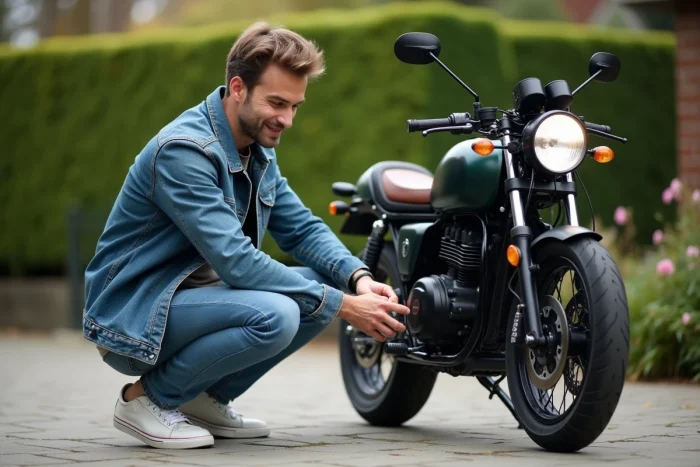
A stark figure, unembellished: 45 km/h. That’s the maximum speed at which the Super Soco TC is allowed on the road, restricted by regulations. But the mechanics demand more. Everything hinges on the electronics: behind this lock, a potential waiting to be unleashed. Forums are filled with solutions, kits, software reprogramming for those who wish to cross the yellow line. No heavy mechanics, just digital sleight of hand.
But crossing this threshold means accepting to pay the price: legal sanctions, loss of warranty, insurance that vanishes in case of trouble. Gaining speed sometimes means losing big on the other side of the scale.
Unrestricting your Super Soco TC: what you really need to know before diving in
The Super Soco TC has all the traits of an agile and silent urban electric two-wheeler. Under the hood, a Bosch brushless motor of 2300 W, 150 Nm of torque; enough to ensure much more than the modest 45 km/h imposed by factory restrictions. Technically, the machine can zip towards 65, 70 km/h without flinching. But it’s not the mechanics that limit it, it’s compliance. The electronic controller, the firmware, everything is set to stay within the lines.
Before tinkering with anything, check the version of your Super Soco. Models manufactured after August 2019, notably the TC Max, are locked: reprogramming is impossible, the firmware blocks any manipulation. For earlier versions, the door remains ajar, but with caution. Sometimes, a trip to the workshop is necessary to modify the controller; other times, a remote intervention suffices. Nothing replaces a precise diagnosis: each series has its subtleties.
Modifying the electronics means losing the manufacturer’s warranty. Any intervention, even purely software-based, voids the coverage. And what about range? It takes a hit. More speed means a more stressed 60V Panasonic lithium-ion battery, accelerated wear on connectors. On the legislative side, the message is clear: an unrestricted scooter has no place on public roads. Only use on a private circuit is tolerated. Otherwise, expect to see your vehicle seized, face a fine, or lose your insurance in case of an accident.
To go further, a complete file exists: discover how to unrestrict a Super Soco TC with Muchos, with a detailed technical point on the risks for the motor. Before taking action, weigh every aspect: performance does not justify the loss of your rights or taking unnecessary risks.
What are the methods to unrestrict an electric motorcycle or scooter?
Modifying the speed of the Super Soco TC involves intervention on the electronic controller. This box controls the power sent, sets the speed limit, and influences acceleration. Several methods exist, but each begins with a check: is your model compatible? What version of firmware? These questions are essential before any intervention.
Reprogramming the controller
The most common method is reprogramming the controller. It allows changing internal parameters to unleash the power and push back the maximum speed. This operation can be done in a workshop or, depending on the case, remotely via professional diagnostics. It remains reversible: it’s possible to reinstall the original configuration if needed.
Here are the processes generally used to modify the controller:
- Sending the controller: some models require you to remove the controller to send it to a specialist, who reprograms it and then sends it back ready to be reinstalled.
- Track mode: on some electric scooters, there is a “track mode” accessible via a switch or software option, provided you have the compatible firmware. This mode allows you to exploit the full power of the motor on closed terrain.
A detail not to be overlooked: an unrestricted vehicle should only operate on a private circuit. Going through a professional limits risks for the motor and ensures a clean operation, especially on newer models. Since 2020, some dealers even require a track use certificate before any intervention. Caution is advised; each step must be taken in accordance with the manufacturer’s guidelines to avoid any incidents and maintain the reliability of your Super Soco TC.

Risks, legislation, and impacts on safety: everything that unrestricting entails in daily life
Unrestricting a Super Soco TC is not just a numbers game. Going from 45 to 70 km/h transforms the riding experience but also brings tangible consequences for the safety and legality of each trip. The regulations leave no room for doubt: any modified vehicle must remain confined to the private circuit. Riding on public roads exposes you to legal action, seizure of the two-wheeler, and loss of any compensation in case of an accident.
Modifying the electronic controller voids the manufacturer’s warranty. No more coverage for the lithium-ion battery, the Bosch motor, or any component of the electrical system. But the risks are not just administrative: the battery undergoes more intense cycles, range decreases, and connectors may wear out prematurely. As for the NMC lithium-ion battery, already sensitive to temperatures, its lifespan may be potentially reduced.
Finally, safety does not depend solely on the motor. The original tires, sometimes deemed unsuitable for the new power, the brakes designed for a limited speed, the geometry intended for the city: all of this must be closely monitored after modification. Unrestricting your Super Soco TC means stepping outside the framework of urban electric mobility designed for peace of mind. Between freedom and responsibility, everyone must choose their balance, but the road never offers a joker.