Your robot vacuum displays 5,000 Pa on the box, while your neighbor’s shows 10,000. Does the second one clean twice as well? Not necessarily. The suction power in pascals has become the key selling point for manufacturers, but this figure alone tells only part of the story. To choose a model suitable for your home, you need to understand what pascals really measure, and then cross this data with other concrete criteria.
Why pascals cannot be compared from one brand to another
The pascal (Pa) measures a difference in pressure. When a robot vacuum creates a vacuum, outside air rushes in to fill the void and carries dust with it. The stronger the vacuum, the higher the theoretical suction force.
The problem lies in the measurement method. Some manufacturers report the maximum pressure of the motor alone, without the nozzle or filter. Others measure the vacuum in a complete configuration, with the collector and brush in place. Two robots displaying the same pascals can have very different suction capabilities depending on the method used.
This lack of standardized protocol is particularly evident among manufacturers that display values above 10,000 Pa. An article detailing the suction power in Pa on Madmoizl Déco explains well how to interpret these figures without falling into the marketing trap. Remember that a difference of a few hundred pascals between two competing models often has no practical significance.
Suction power on hard floors and carpets: useful thresholds
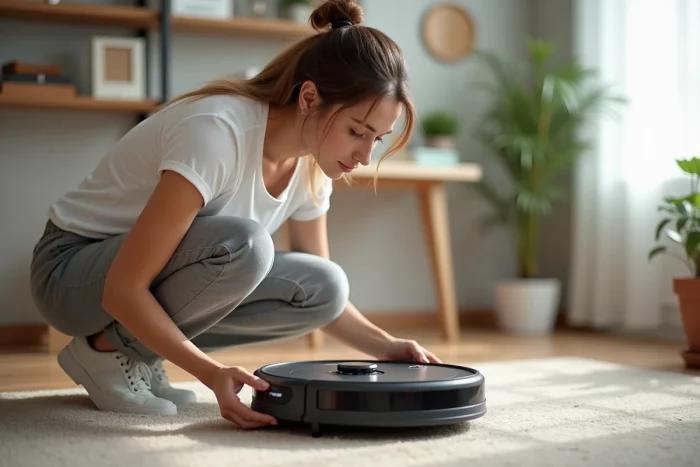
Have you noticed that your robot cleans the tiles very well but struggles on the living room carpet? That’s normal. On a smooth surface, the rotating brush does most of the work. The vacuum in pascals mainly comes into play to dislodge debris trapped in the fibers of a carpet or a long-pile rug.
According to the Eufy buying guide published in 2026, a robot between 2,000 and 4,000 Pa is sufficient for typical household use: dust, crumbs, pet hair on hard floors and thin carpets. Beyond this threshold, the gain on hard floors becomes marginal. The extra power is mainly useful for thick carpets and rugs.
In other words, there’s no need to aim for the highest number if your home is entirely tiled or has hardwood floors. A model in this range will do the job without unnecessarily draining its battery.
When to aim beyond 4,000 Pa
If your interior has several medium-pile rugs or a thick carpet, a more powerful robot is justified. Most recent models offer a “boost” mode that automatically increases power on textile surfaces, detected by sensors.
Households with long-haired pets also benefit from stronger suction. The hairs get tangled in the fibers and resist more than simple surface dust.
Robot vacuum: criteria that matter as much as pascals
Focusing your choice solely on suction power is like buying a car only for its top speed. Several parameters directly influence cleaning efficiency on a daily basis.
- Airflow (expressed in liters per minute) indicates the volume of air the motor moves. A high vacuum without sufficient airflow does not transport dust properly to the collector. Both values work together.
- The design of the main brush radically changes the outcome. A rubber blade brush picks up pet hair better than a traditional bristle brush, even at equal suction power in pascals.
- The navigation system (camera, laser, or infrared sensors) determines the actual coverage of the floor. A powerful robot that passes over the same spot twice and misses a corner of the room will be less effective than a less powerful but methodical model.
- The battery life determines the area that can be cleaned on a single charge. A maximum suction mode drains the battery much faster than the standard mode.
Balancing power, noise, and autonomy: the real trade-off
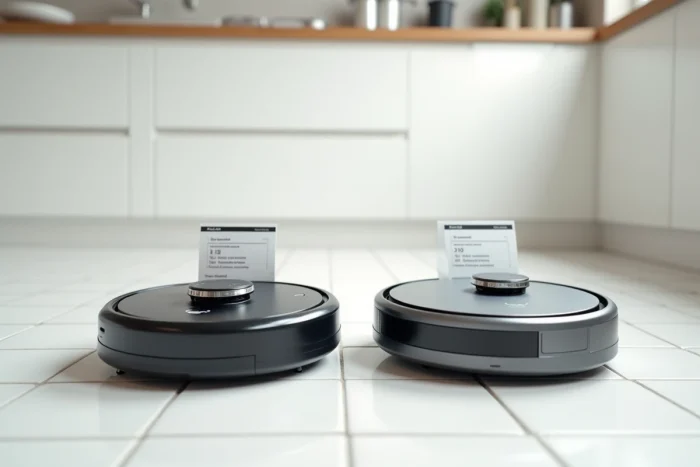
Increasing suction power has a direct cost: noise and runtime. A robot pushed to the max consumes more energy and runs its motor faster, generating more decibels.
For a scheduled daily use during your absence, this compromise is not a problem. If you start the robot in the evening while watching a movie, the quiet mode with reduced power will be your true ally.
Most current mid-range models manage this trade-off automatically. The robot starts in eco mode on tiles, then switches to boost mode on carpets. This smart management preserves battery life while ensuring proper cleaning on each type of surface.
Emptying station and collector maintenance
A often overlooked point: the capacity of the dustbin and the presence of an automatic emptying station influence perceived efficiency. A very powerful robot with a small collector fills up quickly. Suction power decreases when the bin is full, regardless of the number of pascals advertised.
An automatic emptying station maintains consistent performance from one cycle to the next. For large homes or households with pets, this accessory weighs more in the final result than a few thousand pascals extra.
Choosing your robot vacuum in pascals: the reading grid
Rather than a ranking by raw numbers, cross the advertised power with your actual situation:
- Hard floor housing without pets: a model around 2,000 Pa with good navigation is more than sufficient.
- Mixed floors (hardwood and thin carpets) with pets: aim for the range of 2,000 to 4,000 Pa, with a rubber brush and automatic boost mode.
- Thick carpets or abundant long hair: look for models above 4,000 Pa, ensuring that airflow and autonomy are adequate.
Always compare robots from the same brand with each other before comparing between brands. Since measurement protocols differ, internal comparison remains more reliable. Also, check if the manufacturer specifies the testing method (motor alone or complete configuration).
Pascals remain a useful but partial indicator. A well-chosen robot vacuum is a coherent set: power suited to your floors, precise navigation, sufficient autonomy for your area, and easy maintenance of the collector. The number on the box does not replace this overall reading.