ABS braking does not always shorten stopping distance on dry ground, but it keeps the car on its trajectory. This difference, subtle on paper, nonetheless prevents chain reactions of accidents. However, most collisions involving vehicles packed with assistance features occur at low speeds, often during simple parking maneuvers or changes in direction.
Experienced drivers often imagine that years of experience are enough. This is a false sense of security: technologies and rules evolve quickly, and only those who update their reflexes fully benefit from modern road advantages. Knowing how to handle these tools and integrate current techniques transforms safety, but also the efficiency of every journey.
Why dynamic driving changes everything on the road
On the road, every moment is crucial. Dynamic driving is not about speeding or overtaking recklessly. It’s about anticipating, reading your environment, and dealing with the unexpected that arises without warning. In this game, the best rely on their senses and adjust their speed, monitoring the mechanics, as the reliability of the car determines road safety.
This approach requires constant attention to details that escape a distracted gaze: a slight loss of grip, a shadow that lengthens, a hesitant pedestrian. Many loss of control incidents occur during seemingly innocuous maneuvers. Implementing a preventive driving style reduces the frequency of unpleasant surprises and protects everyone sharing the asphalt.
Here are the pillars of this driving style:
- Manage your stress and adapt: every decision, every brake or accelerator input, affects road handling.
- Master the rules of the road: respecting signage means anticipating traps and safeguarding all road users.
- Check the vehicle’s condition: tires, brakes, lights… neglecting any of these elements increases the risk of incidents.
For everything you need to know about dynamic driving, take the time to explore resources that teach method, vigilance, and adjusted reflexes. A skilled driver leaves nothing to chance: they observe, they correct, they engage in a driving focused on safety, without ever losing sight of the overall traffic picture.
Essential techniques for driving with efficiency and safety
Controlled braking: the foundation of dynamic driving
Braking does not tolerate approximation. Relying on progressive braking means anticipating deceleration and maintaining vehicle stability. In emergencies, the rule changes: press firmly, without letting up, to take full advantage of braking potential. On slippery roads, you need to modulate pressure to avoid wheel lock, especially if ABS is not available.
Some points deserve special attention:
- Use of the left foot: reserved for those who master their subject, it increases responsiveness on automatic transmissions.
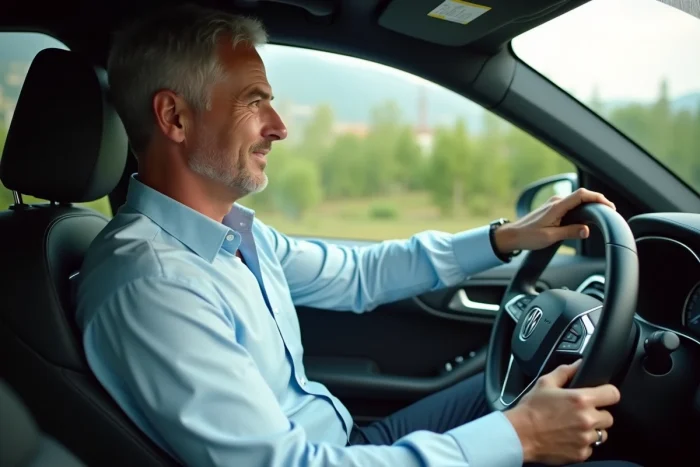
- Hand position on the steering wheel: opt for the “9 and 15” grip for precise and responsive handling.
Turns and grip: the art of maintaining control
Approaching a turn requires preparation and flexibility. Slow down before entering, then gently accelerate out to maintain control of the vehicle. On wet roads, exercise extra caution: slipping is particularly threatening in tight curves or on a dirty road.
Manual or automatic transmission: adapt your technique
Manual driving allows for fine control of engine speed. With an automatic transmission, focus on pedal modulation and steering. To drive more efficiently, adopt eco-driving reflexes: low-rev gear changes, anticipating slowdowns, maintaining a steady speed.
Experience is built on the ground. To improve, multiply situations, observe how the car reacts, adjust your posture. Dynamic driving is learned and perfected, trial after trial, requirement after requirement.

Courses, training, and electronic aids: allies of responsible driving today
Getting a license is just a step. Continuous training shapes drivers capable of predicting, analyzing, and adapting to the unexpected. Advanced training courses, offered by specialized centers or associations, are aimed at those who want to sharpen their reflexes and solidify their preventive driving. On a track or in real conditions, these sessions provide the opportunity to test emergency management, push the limits of grip, and refine vehicle control in situations.
Driving simulators bring a new dimension to training. They allow for the automation of actions without risking accidents, working on trajectory, braking, and decision-making under pressure. This immersive pedagogy has found its place in modern learning, making the concept of road safety tangible.
Cars are evolving, electronic aids are becoming widespread: stability control, assisted emergency braking, adaptive cruise control. These devices do not absolve one from thinking, but they support vigilance and the ability to anticipate. To use them well, it is helpful to discover them during training or request a demonstration during vehicle maintenance.
Ultimately, the challenge remains clear: to develop responsible driving that can protect every person on the road while pushing one’s own limits. Because behind the wheel, competence has no ceiling: it is cultivated, refined, and makes all the difference when the unexpected appears in the rearview mirror.